


What are Vasudevas like?
Questioner: Please explain the next mantra ‘Aum namo Bhagavate Vasudevaya’.
Dadashri: Vasudev Bhagwan! These are beings that have evolved from being ordinary human beings (nara) into God – Narayan. To such beings I bow. When they become Narayan, they can be called Vasudevas.
Starting from the time of Lord Rushabhdev until now, there have been nine Vasudev Bhagwans. Vasudev means those who have evolved from an ordinary human being into God; that state is called Vasudev. There is no penance or renunciation here. Along with every Vasudev, there will also be their opponent called a Prati-Vasudev (prati - opposite). On the one side a Vasudev is born and on the other a Prati-Vasudev. They are the PratiNarayan! Also along with these two, there will be nine Baldevas, as brothers or stepbrothers of Vasudev. Krishna is Vasudev and Balram is Baldeva.
Who is the Vasudev of this current time cycle? Lord Krishna. So therefore this obeisance reaches Lord Krishna. It reaches all the protecting deities of Lord Krishna.
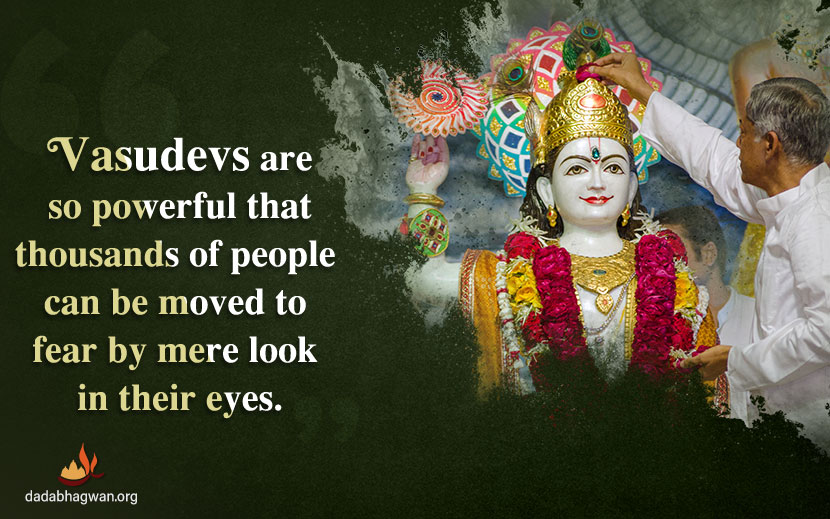
What are these Vasudevas like? They are so powerful that thousands of people can be moved to fear by mere look in their eyes. What is the indication of the cause (karmic) for becoming a Vasudev? It is when a person can die from fear by merely looking into their eyes; such is the power they possess. These qualities are apparent in a Vasudev-to-be many lifetimes ahead. When they walk, the earth would shake! Yes, the earth actually makes a noise when they walk, and this happens many lives ahead to them becoming a Vasudev. The cause (karmic) of becoming a Vasudev is very different. Their very presence causes chaos in the world. Talks of Vasudev is a different matter altogether! One can tell a Vasudev at the time of his birth. A Vasudev to be can be recognized from many lives ahead because of his attributes. A Tirthankar to be cannot be identified but Vasudevas can. Their characteristics are entirely different altogether. The same goes for the PratiVasudev!

subscribe your email for our latest news and events
Dada Bhagwan Foundation, Adalaj is a spiritual non-profit organization whose goal is to spread peace, harmony and everlasting bliss to the whole world through the spiritual science of Akram Vignan.
Ask a question and Get an assured response


