


Shree Mahavir Bhagwan: Garbh Haran, Birth, and Diksha of the Twenty-fourth Tirthankara
We have read in detail about Lord Mahavir’s first to seventeenth, and eighteenth to twenty-seventh lives. All Tirthankaras are born as Kshatriyas, but due to the utsutra prarupna fault committed in the life as Marichi, Lord Mahavir had to initially reside in the womb of a Brahmin woman. Later, the celestial beings transferred the embryo from womb of Brahmini to the womb of Mata Trishala - this is considered one of the ten unprecedented and miraculous events. Lord Mahavir took birth for the upliftment of people. Those who were with Him during that time were indeed extremely fortunate! Let us now read in detail the divine story from this garbha haran aashcharya to His Diksha.
Lord Mahavir Swami – The Garbh Haran Aashcharya
At the time of Lord Mahavir Swami’s birth, a great aashcharya, an extraordinary event took place. Something that never happens, but it happened then. It is counted among the ten great spiritual wonders. The soul of Lord Mahavir had first entered the womb of a Brahmin woman named Devananda. His Brahmin father’s name was Rishabhdatta, and they lived in a village called Brahmankund. Devananda Mata saw fourteen auspicious dreams entering through her mouth, which is a sign that is typically experienced by all the mothers to whom Tirthankaras are going to be born. Mata Devananda was filled with great joy, and all the interpreters predicted that a Tirthankara would be born from her womb.
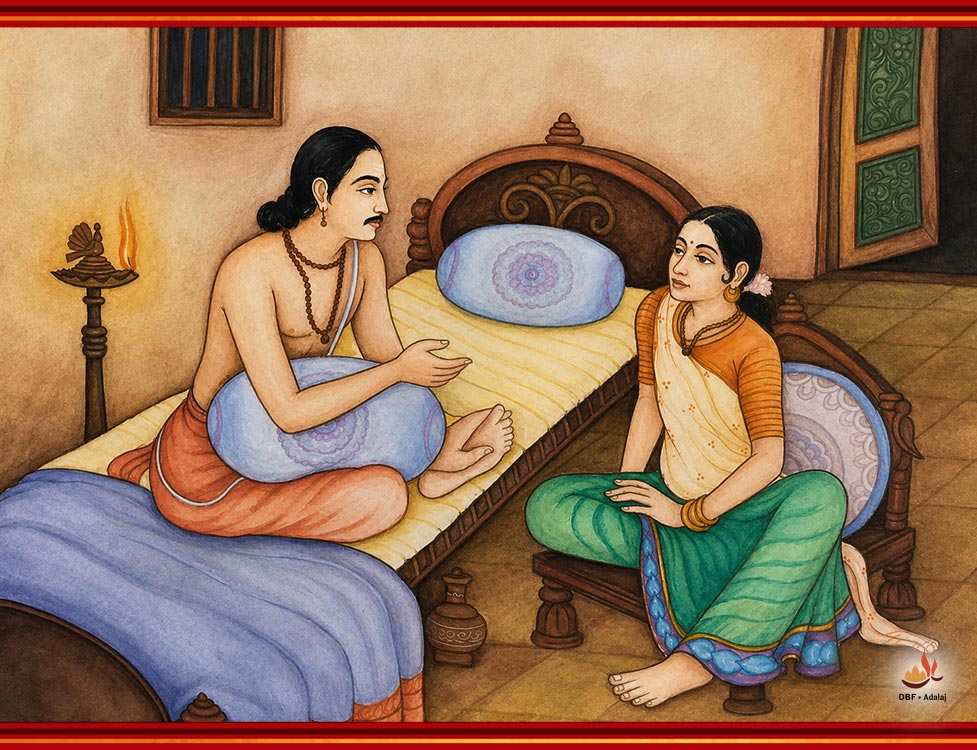
After 82 days of pregnancy, the throne of Indra in the celestial realm began to tremble; placing his awareness there, he realized that Lord Mahavir, who is going to become a Tirthankara, was going to be born from the womb of Devananda, a Brahmin woman. This was something that never ever happens! For Tirthankaras are always born in the Kshatriya lineage. All the sixty-three Shalaka Purushas (human beings with extraordinary, super human energies and accomplishments. They are: 24 Tirthankars, 12 Chakravartis, 9 Vasudevs, 9 Baldev, and 9 Prativasudevs) who have existed were Kshatriyas, and even among them, they were kings of the highest order; this is not a role meant for an ordinary person.
For a Tirthankara Lord to be born in a Brahmin lineage instead of a Kshatriya lineage had never occurred in history. One reason given for this is that in His previous birth as Marichi, when He established a new Tridandi path and adopted Brahmin-like practices such as keeping a shikha and altering established conduct, many of His subsequent births took place in the Brahmin caste. As a result of this, in this particular life, He was to be born as a Brahmin in the womb of Devananda Mata. In the birth as Marichi, due to the pride of caste, thinking, “I am a Kshatriya and all other castes are inferior; I am superior”, He did not follow the path shown by Lord Rishabhdev, and instead walked on His own separate path. Due to these and many other causes, Lord was destined to take birth into a Brahmin lineage.
Considering this situation to be extremely serious, the celestial beings decided, “No matter what happens, we must transfer this embryo and place it into the womb of a Kshatriya mother.” The celestial beings possess all kinds of spiritual powers. At that time, in the Kshatriya lineage, Queen Trishala, the wife of King Siddhartha, was also pregnant. After 82 days, the celestial beings carried out what they had decided; the embryo that was in Trishala Mata’s womb was placed into Mata Devananda’s womb, and the soul of Lord Mahavir, which was in Mata Devananda’s womb, was placed into Queen Trishala’s womb. What an extraordinary task the celestial beings accomplished! To interchange two embryos is an extremely difficult act, yet the celestial beings are able to carry out anything and everything.
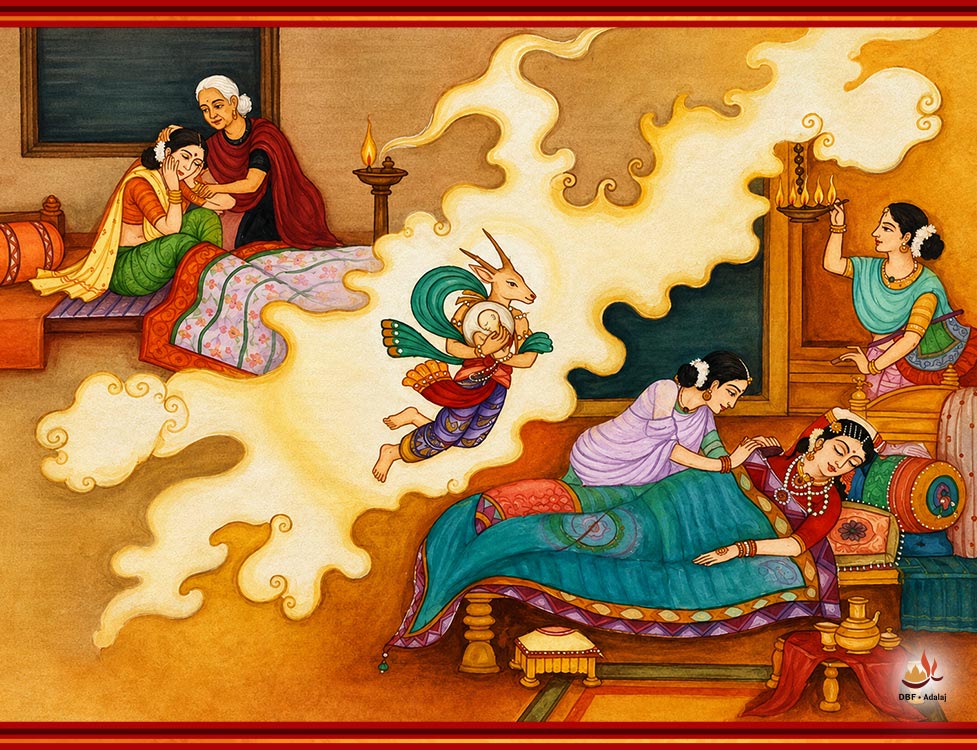
When the transfer of the embryo took place, that very night, Mata Devananda saw the same fourteen dreams that had appeared to her leaving through her mouth, while on the other hand, Trishala Mata saw those same fourteen dreams entering her mouth. Mata Trishala was filled with great joy, but Mata Devananda became deeply sorrowful. She was gripped with fear, thinking, “Has someone taken away my embryo? Has something happened to it?” She began to mourn intensely. However, later, it was realized that the embryo was still there, though she remained unaware of the actual transfer that had taken place.
With the arrival of the fourteen dreams, Trishala Mata was filled with immense joy, and the interpreters declared, “A Tirthankara Lord will be born from your womb.” The king and queen were overjoyed and began engaging in service, devotion, charity, and righteous deeds. From the very moment Lord entered the womb, the prosperity of King Siddhartha’s kingdom began to increase greatly; wealth, harvest, happiness, and overall well-being flourished among the people. Such extraordinary effects manifested simply with the presence of a Tirthankara in the womb. What immense and powerful merit karma!
Lord Mahaveer Swami, while in His mother’s womb, possessed three types of knowledge - Shrut Gnan, Mati Gnan and Avadhi Gnan. Even in the womb, Lord was fully aware. He was deeply devoted to His parents, and when He realized that His movements in the womb were causing discomfort to His mother, He chose to remain completely still, without moving His hands or feet, staying in a very restrained posture. As a result, Trishala Mother felt no movement at all, which caused her great anxiety, “Has something happened to my child?” Because of this worry, she lost her appetite, could not sleep, and stopped speaking, becoming deeply troubled and distressed within.
Mata Trishala shared this concern with King Siddhartha, and he too felt deeply distressed on hearing it. Both parents became extremely worried. Through Avadhi Gnan, Lord Mahavir became aware that His mother was very unhappy and had stopped eating and drinking, so He gently moved just the tip of His toe, so that she could feel His presence. With this slight movement, Mata Trishala felt reassured, realizing that Lord was conscious and that the foetus was alive.
Because His parents were deeply attached to Him, Lord Mahavir, even while in the womb in the seventh month itself, He made a firm resolve, “I will take Diksha only after the demise of my parents; if I renounce while they are alive, it will cause them immense sorrow, which they will not be able to bear.” Thus, even in the womb, He fulfilled His duty of ensuring that His parents would not suffer.
With Mata Trishala, many celestial beings would engage in beautiful spiritual conversations and joyful interactions. While Lord Mahavir was in the womb, the celestial beings took great care of Mata Trishala. Around the clock, in turns, different Devis remained present in her service, because the Lord resided in her womb and serving the mother was considered equivalent to serving the Lord Himself. With deep devotion, groups of Dikkumari Devis, in sets of eight, would come and serve her in every way, some would help her bathe, some would help her rest, and others would offer her food. Everyone took great care, and Trishala Mata remained very happy and content.
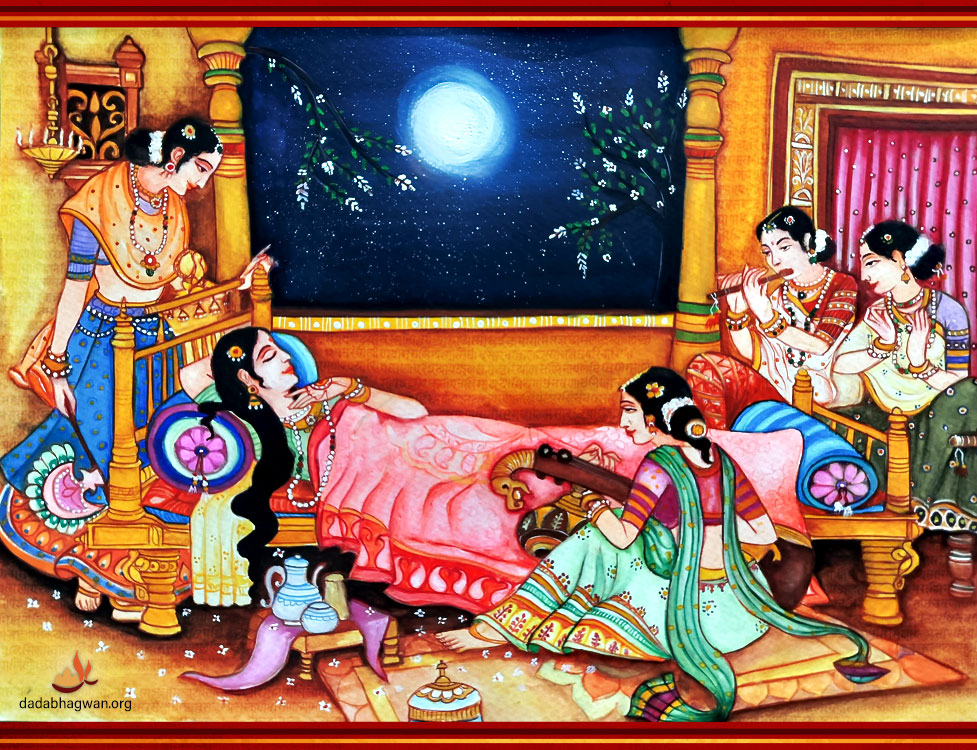
While Lord Mahavir was in the womb, Samkiti (One who has attained the right belief; Self-realized) Devis remained in the service of Trishala Mata. Being in such close association, Tishala Mata frequently engaged in spiritual discussions with them. Other worldly thoughts did not arise in her at all, because a Tirthankara, the Lord of the fourteen realms, was in her womb. As a result, her entire inner state transformed, and she developed a deep liking for virtuous spiritual thoughts and discussions. Thus, with the Samkiti Devis who served her, Trishala Mata would engage in spiritual conversations.
Trishala Mata had a deep desire to understand many things, so she would ask numerous questions to the Devis, and the Samkiti Devis gave very beautiful answers. Whenever the Devis were unable to figure out the answer to a question, they would seek guidance from Tirthankara Mahavir Bhagwan present in Mata Trishala’s womb, and instantly, the answer would arise within them. The responses that emerged in the presence of the Lord carried His affirmation and were completely accurate, without the slightest error. Some of those answers are as follows:
- What is considered the most beautiful thing in this world?
One’s own pure Soul; Atmatattva (element that is the Soul) is the most beautiful of all. - What is the characteristic of the Soul?
Chaitanyabhaav (filled with the intent of the self); the Soul is Chaitanya swaroop (embodiment of the Self). There is nothing in it other than consciousness. The Soul is absolute Chaitanyaghan swaroop (in the form of solid, unbroken Knowledge and Vision). - What is the form of the Soul?
It is Gnan swaroop (the Real form as Knowledge); it is only keval Gnan swaroop (form of/as absolute Knowledge). There is nothing in it except Knowledge. Everything other than Knowledge belongs to the non-Self. - What is called dharma?
When a substance remains in its intrinsic functional properties, qualities of the Self that is called dharma. When the Soul abides in its own true qualities, it is called Swadharma (religion of the Self) or Atmadharma (inherent function as the Self). - What is the highest conduct?
State of absolute detachment is the highest of the highest conduct. Where there is no attachment nor abhorrence even to the slightest extent. One who does not develop even a trace of hatred toward those who cause them great trouble, and does not develop even a trace of attachment toward those who offer great help, they are called absolutely detached. - Who is a sinner in this world?
The one who causes suffering to others. The moment one gives even the slightest pain to another, sin begins. One who criticizes or speaks ill of any revered deity, religion, or guru is considered a grave sinner in this world. - Who is content in this world?
One who remains content within the Self, that is, within the Soul. Such contentment arises only after realizing the Self; until then, it is not possible. - Where does a soul go that has neither merit karma nor demerit karma?
It attains Moksha (liberation). - Who is discerning in this world?
One who can discern between the essential and the non-essential is called discerning. People in the world often mistake the non-essential for the essential, that is called ignorance. One who is deeply aware is truly discerning. - Who in this world is truly brave?
One who can forgive even an enemy. The one who doesn’t need to forgive, but to whom forgiveness comes naturally and effortlessly! Where one does not even perceive the other as an enemy, but sees them as the Real form as the Self. - Who is the greatest fool in this world?
One who attains this human birth yet does not awaken the Soul, does not walk the path of liberation, and does not work for the salvation of the Self, that person is called a fool. - Who is called a hero?
One who conquers all the inner enemies in the form of karmas is the true hero. One who destroys the obstacles on the path to liberation, inner anger, pride, deceit, greed, attachment and abhorrence, such a person is truly called a veer (hero). - Who is called a Jin?
One who has conquered all moha (illusory attachment) is called a Jin. - Who is the highest of all?
One who knows all the eternal elements. The Knower of all eternal elements is truly considered the highest of the high. - Who is a Mumukshu?
One who has a constant longing for liberation, day and night desiring only Moksha, is a true Mumukshu. Throughout the day, the thought remains within, “When will I attain liberation? When will I realize the Self? When will I meet a Gnani (the One who has realized the Self and is able to do the same for others)? When will I be free from the bondage of worldly life?” Such a person is truly called a Mumukshu.
In this way, while Bhagwan Mahavir was in the womb of Mata Trishala, the Devis remained constantly present and took care of all her needs and service.
Birth
Lord Mahavir was born on the auspicious 13th day of the waxing moon during the Hindu calendar month of Chaitra. Lord had a beautiful, golden-hued body. His laanchhan is the lion. His divine form was so captivating that one would be enchanted simply by beholding Him. At the time of His birth, countless celestial beings gathered one after another for His darshan. After His birth, all the Indras carried Lord to Mount Meru for the ceremonial abhishek. For His first prakshal (sacred bath) and darshan, crores of Devas and Devis brought waters from holy rivers, carrying such vast quantities that it seemed as though entire rivers were brought to be poured on Lord.
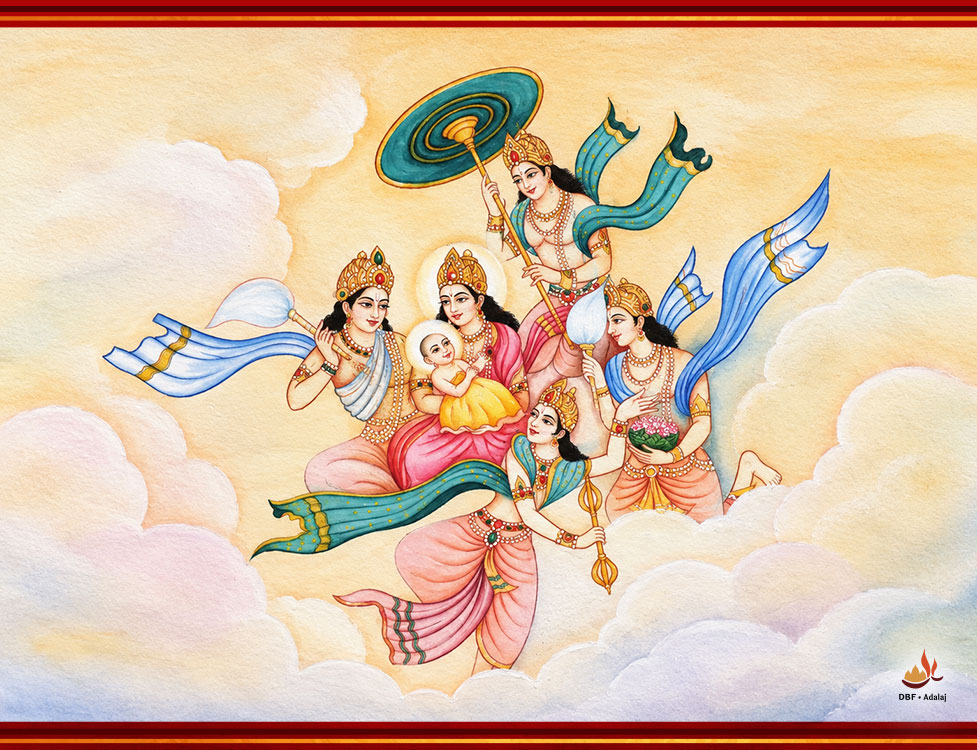
At that time, Indra Dev thought, “So much water over Lord! He is delicate; how will He be able to bear it?” Lord Mahavira immediately understood Indra’s doubt and gently pressed His toe against Mount Meru, causing the entire mountain to sink. Seeing this, Indra realized that his doubt was mistaken. A Tirthankara Lord is the Lord of all Lords, the Lord of the fourteen realms; how can one even measure His strength! Filled with joy, everyone then performed Lord’s abhishek.
All the Deva-Devis felt immense affection on seeing Lord in the child form. There was immense happiness everywhere that a Tirthankara Lord had incarnated to liberate countless souls. With great joy, the celestial beings served Lord. Without Mata Trishala even realizing, they quietly placed a replica child beside her and took the infant Tirthankara Lord to Mount Meru for the abhishek, after which they would return Him to His original place near His mother. Even people rushed eagerly just to catch a glimpse of Lord from a far.
How blessed Trishala Mata must have felt, with a Tirthankara Lord residing in her womb twenty-four hours of the day! What immense joy she must have experienced! All the Dikkumari Devis lovingly nurtured Lord. When Lord was twelve days old, great prosperity began to arise throughout the kingdom. Wealth, happiness, food, water, and people’s happiness increased significantly. Seeing this growth, His father named Him “Vardhaman”. Through Avadhi Gnan, the Devas foresaw that Lord would face many upsargs (externally induced afflictions/sufferings). Among all the twenty-four Tirthankaras, Lord Mahavir endured the greatest number of such afflictions, yet He remained completely unwavering, exhausted all His karmas, attained Keval Gnan, and ultimately Moksha. His courage was truly extraordinary; therefore, the Devas gave Him the name “Mahavir”.
Childhood
As Lord Mahavir was lovingly raised by Trishala Mata, He grew to the age of eight. At the age of eight, preparations began for His education. Since Lord was a prince, King Siddhartha started searching for the best possible guru who could impart all knowledge and skills to Him. When the Devas and Indras came to know of this, they wondered, a guru for Lord! How can an ordinary guru teach the Lord of the fourteen realms? How strange it sounds? A Tirthankara Lord is revered as the Lord of all Lords of the whole world. Whom the entire world regards as a Guru; how then can He become someone’s disciple? The Devas did not like this, and so they devised a different plan.
Lord Mahavir’s father admitted Him into the gurukul, but seated Him on the guru’s seat, at a higher place, while all the others sat below; and at just eight years of age, Lord began teaching everyone. Lord, in the womb itself, was endowed with Shrut Gnan, Mati Gnan, and Avadhi Gnan, and being a Tirthankara Lord, He did not need to be taught much; He already knew everything. From Lord’s speech emerged, for the first time, a beautiful system of grammar known as Indra Vyakaran. Whenever the child Lord went out to play or roam with the princes, the people of the entire city eagerly longed for His darshan; merely seeing Him brought a sense of deep peace and inner transformation within them.
In the celestial realm, the Indra Devas would often speak highly of Tirthankara Lord Mahavir, praising His courage, beauty, and greatness! However, one Deva did not accept this easily and thought, “Let me test Lord Mahavir.” Taking the form of a huge serpent, he approached the eight-year-old Lord, hissing loudly. At that time, Lord was playing with other princes; upon seeing the fierce serpent, all the other princes became frightened and ran away, but Lord remained completely steady and unmoved.
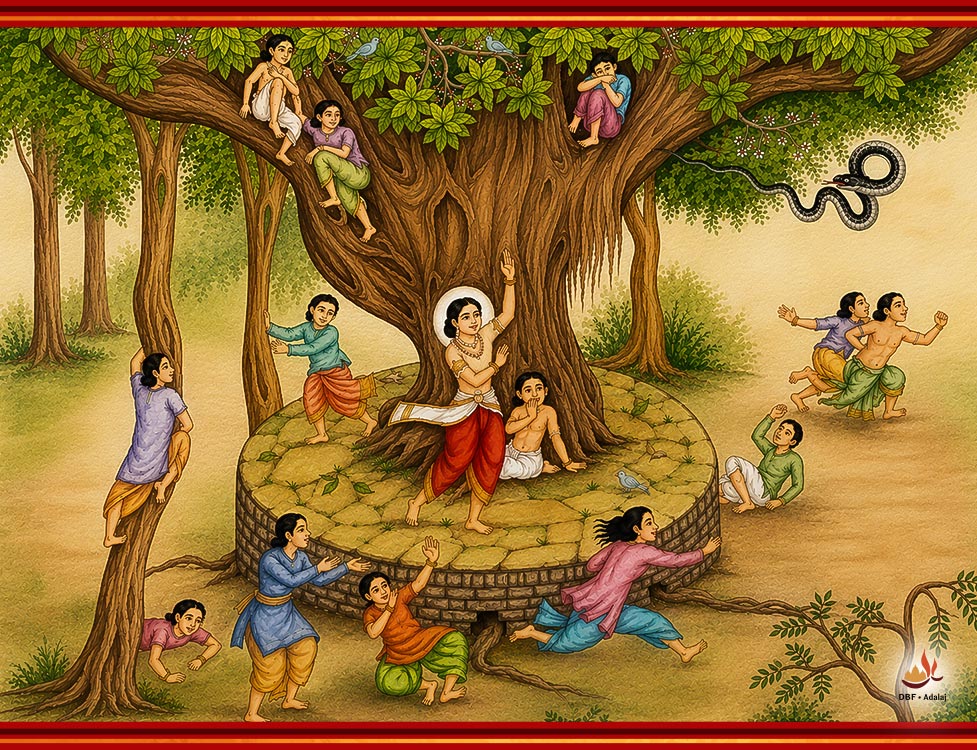
The One who grants fearlessness to the entire world, how can He be afraid? The eight-year old Lord was not afraid at all; instead, He calmly caught the serpent by its tail, whirled it, and flung it away. Seeing this, all the princes became joyful and resumed their game. That same Deva, wishing to test Lord again, took the form of an eight-year-old prince and joined the other princes in their game. The rule of the game was that whoever lost would become a horse, and the winner would ride each of them in turn. In this game, Lord Mahavir won, and all the princes became horses while Lord rode on them one by one. Then that Deva too became a horse, and Lord mounted him; suddenly, using his tricks, the Deva enlarged his body and lifted Lord to a height like Mount Meru. Seeing this all the princes were frightened, wondering what would happen to Lord? While the Deva felt pleased with his act.
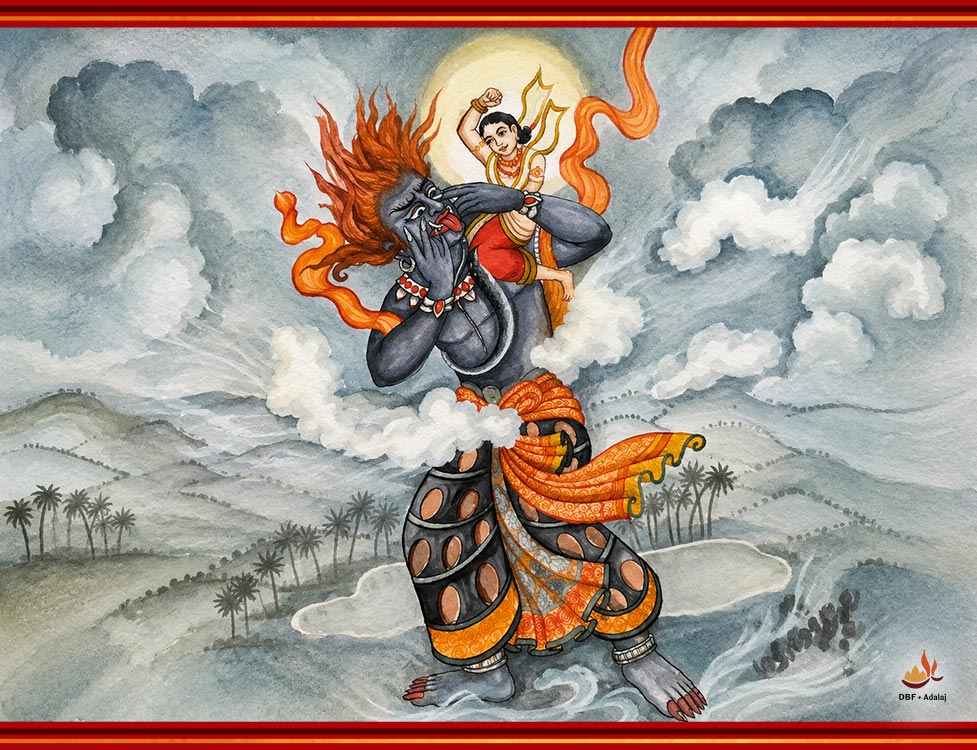
Then Lord Mahavir Swami showed His true might and struck the Deva’s back with a single fist, upon which the Deva instantly returned to his original small form. Lord possessed such immense strength that He could reduce the entire world to dust with a single blow, yet He never used His power unnecessarily; this was only to teach the Deva a lesson. Then the Deva bowed at Lord’s feet, sought forgiveness, and said, “You are truly even greater than how the Devas had described You, You are indeed Mahavir!” After this, the Deva departed.
Once, a mad elephant was troubling the people of a village, uprooting them with its trunk, trampling them under its feet, and causing great harm. It then came charging toward Lord Mahavir’s palace, where Lord was standing on a balcony. Lord gently addressed the elephant, “What are you doing? Do you realize how many karmas you are binding? Without any reason, you are troubling so many people and even killing them. Therefore awaken, awaken.” Seeing Lord’s gentleness, compassion, and love, the elephant immediately became calm and still then and there. It bowed to Lord with its trunk and quietly walked away.
Lord Mahavir Swami’s gentleness and soothing presence were such that they could instantly calm anyone in front of Him. The quality of a Tirthankara’s serenity is such that no matter how agitated or disturbed a person may be, the moment their eyes meet Lord’s or if they even hear a few of His words, they become completely peaceful; in fact, even before words are spoken, a deep coolness spreads just by looking at Lord’s eyes. His compassion flowed through His eyes. Such was His serenity that no one felt like moving away from Him; the people of the city would eagerly wait, thinking when would Lord come and when will we be able to get a glimpse of Him. Despite facing numerous upasargas and being troubled by many, His serenity remained constant and unchanged.
Once, two Devas were passing through the sky and developed a doubt; they came to Lord disguised as monks, but the very moment they beheld Him, all their doubts vanished instantly. Just by Lord’s mere glance, all their inner spiritual confusions were resolved. How pure and serene His vision must have been!
Marriage and Diksha
As time passed, Lord Mahavir grew into a young man and mastered all the skills. When He came of age, His parents wished for Him to marry, and Mata Trishala requested Him to do so. Despite their persuasion, Lord remained deeply detached and had no interest in marriage, which caused great sorrow to His mother; then Lord reflected that it would be better to marry than for His parents to die in a state of aartadhyan (adverse internal state of being that hurts the self), and on this basis, Lord told His mother that He was ready for marriage. His parents were overjoyed and made grand preparations for the marriage. Lord Mahavir was married to Princess Yashoda. He continued to exhaust His bhogavali karma (the karma that one has no choice but to suffer), and a daughter was born to Him named Priyadarshana, who was later married to a prince named Jamali.
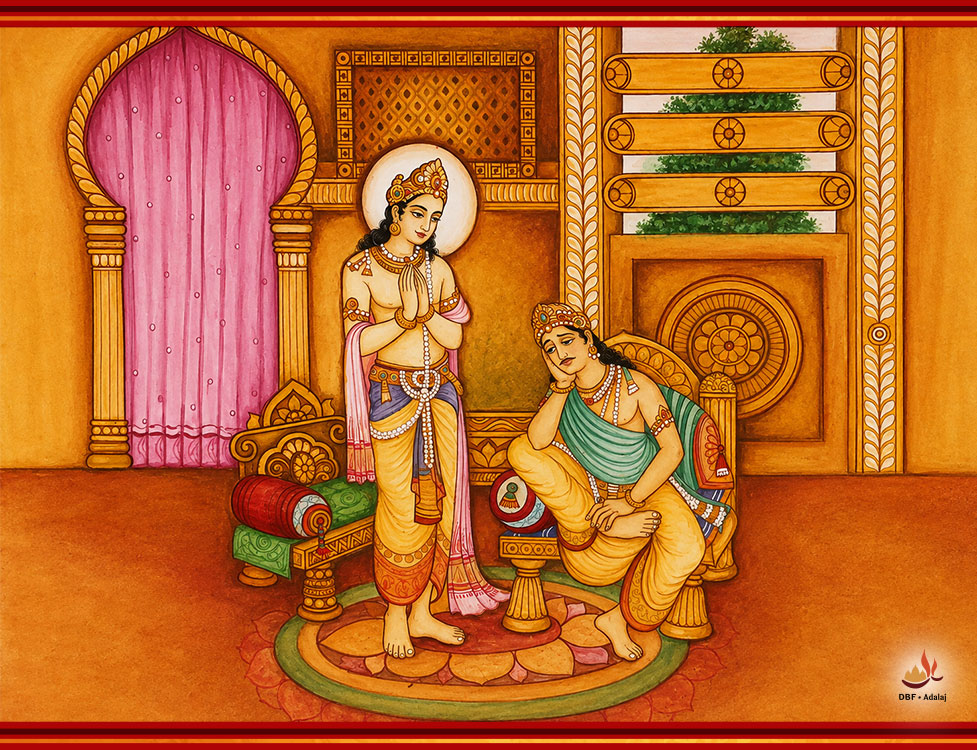
When Lord Mahavir reached the age of 28, His parents passed away. Their demise deeply affected His elder brother Nandivardhan, who was overcome with grief. At that time, he requested Lord to take over the royal throne, but Lord was detached and firmly wished to take Diksha. He clearly told His brother, “I have no desire for the throne. You are the elder; it rightfully belongs to you. I will take Diksha one day; and if you permit, I am ready to take Diksha today itself.” Hearing this, Nandivardhan became even more distressed and said, “I have not yet recovered from the sorrow of our parents’ loss, and if You leave now, it will be another great shock for me.” Lord patiently explained and consoled him, and Nandivardhan eventually agreed, but requested, “Not now, at least for two years, I cannot let You go. Give me time to recover from this grief; after that, I will allow You to go.” Lord accepted this, because how can one attain liberation by causing pain to another? Even causing the slightest suffering to any living being becomes an obstacle on the path to Moksha.
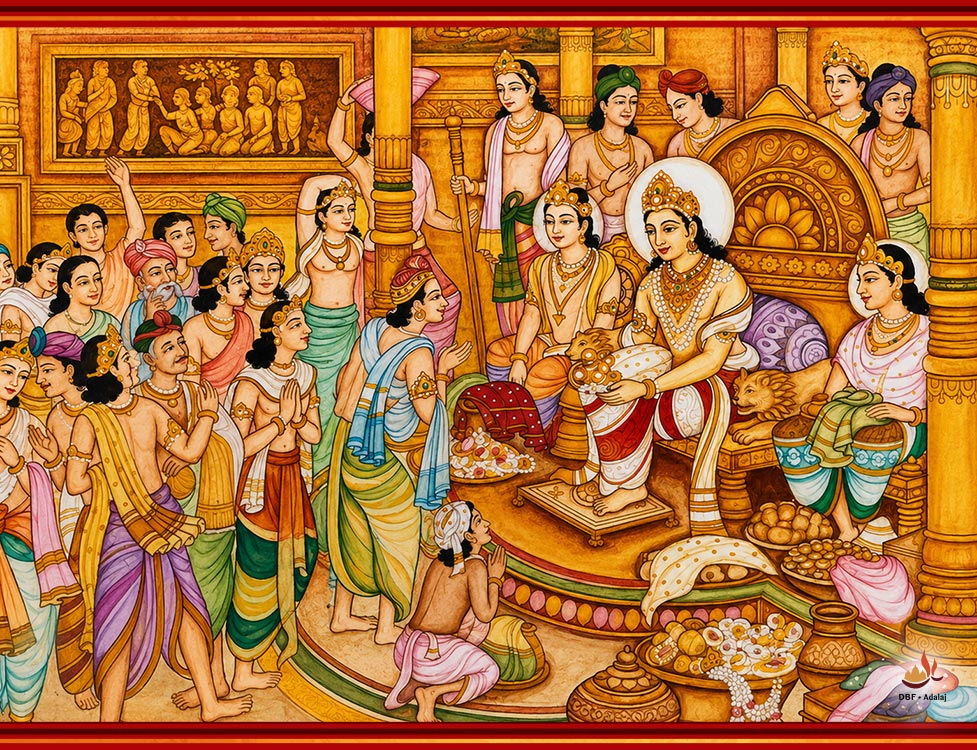
After one year, Lord Mahavir began Varshidan, giving immense charity to all for one year. In His thirtieth year, His Diksha celebration took place, beautifully arranged by the Devas, who even opened the great treasures of Kuber for the charity. At the age of thirty, the moment Lord took Diksha, Manahparyav Gnan (knowledge through which all phases of the mind can be read) manifested within Him. Lord took Diksha and performed the loch (plucking of all the hair on one’s head) with His own hands. Such was His divine beauty that people would become enchanted and even faint upon seeing Him, and to prevent this, Lord subdued His external charm by performing loch.
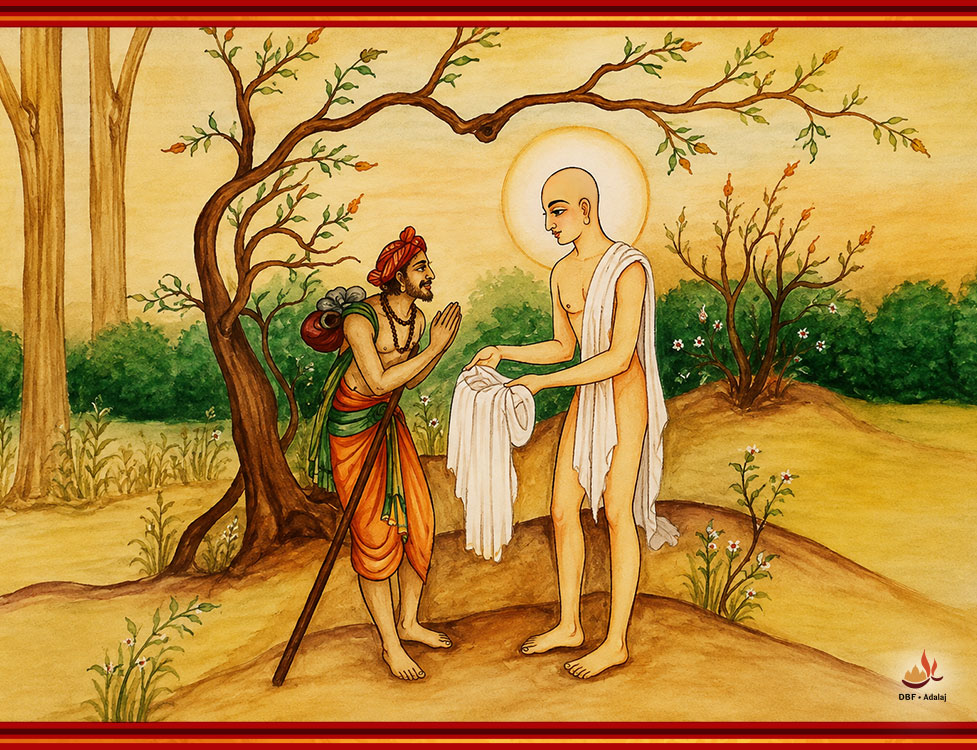
After taking Diksha, Lord Mahavir set out alone into the forest. There, a Brahmin approached Him and said, “Lord, when You gave immense charity before renunciation, I was away earning in another land, so I received nothing. I am very poor and do not even have money for food. Please give me something.” Lord replied, “I have nothing left to give; I have left everything behind. At most, I can give you half of this cloth that I am wearing. It is valuable, you may gain something from it.” Then the Brahmin took half of the Lord’s cloth and went away. When he tried to sell it in a village, someone told him, “If you bring the other half of this cloth, we can get a much higher price, this is very valuable; it could fetch a lakh rupees, we’ll divide it equally, half for you and half for me.” The Brahmin wondered, “How would I get the other half?”, and the man advised, “Follow Him; when His cloth gets caught somewhere, you can take it. Lord won’t even stop to retrieve it.” And indeed, it happened so that the remaining cloth got caught in some bushes, but Lord simply left it behind and walked on, entering a completely Digambar state. The Brahmin then joined both pieces and sold them, earning half a lakh rupees. Now let’s read about the series of extraordinary upasargas that Lord Mahavir endured, unlike those faced by any other Tirthankara or human being.
Related Topic
- Shree Mahavir Bhagwan: Past Lives Part-1 of the Twenty-fourth Tirthankara
- Shree Mahavir Bhagwan: Past Lives Part-2 of the Twenty-fourth Tirthankara
- Shree Mahavir Bhagwan: Upsargas on the Twenty-fourth Tirthankara
- Shree Mahavir Bhagwan: Sacred Teachings to Chandkaushik Snake
- Shree Mahavir Bhagwan: Incidents with Goshala

subscribe your email for our latest news and events
Dada Bhagwan Foundation, Adalaj is a spiritual non-profit organization whose goal is to spread peace, harmony and everlasting bliss to the whole world through the spiritual science of Akram Vignan.
Ask a question and Get an assured response


